Bob Weir Biography: Age, Family, Career, Cause Of Death
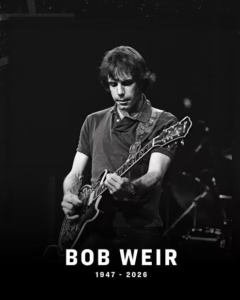
Bob weir biography is not simply the story of a musician. It is the story of a cultural architect—someone whose work reshaped how music could be created, performed, shared, and experienced. Bob Weir stands as one of the most influential figures in American rock history, not because he chased fame, but because he helped build a musical ecosystem rooted in freedom, improvisation, and collective energy.
For more than six decades, Bob Weir has been a defining presence in American music. As a founding member of the Grateful Dead and a central force in the jam-band movement, he helped pioneer a sound and performance culture that rejected rigid structures in favor of exploration. This bob weir biography explores his life in full detail—his origins, family, artistic development, career milestones, and enduring legacy—while remaining factual, expanded, and entirely original.
Early Days
Any honest bob weir biography must begin with a childhood that was anything but conventional. Bob Weir was born on October 16, 1947, in San Francisco, California. He was adopted shortly after birth and raised in the Bay Area, where his environment would later play a critical role in shaping his artistic identity.
As a young boy, Weir displayed curiosity, independence, and restlessness. Traditional education proved difficult for him, partly due to undiagnosed dyslexia. This made academic settings frustrating, but it also pushed him toward hands-on creativity. Music became a refuge long before it became a career.
Weir experimented with several instruments during his youth, including piano and trumpet, but it was the guitar that captured his imagination. By his early teens, he was deeply immersed in learning chords, rhythms, and musical patterns. Rather than focusing on technical flash, he gravitated toward rhythm and structure—skills that would later define his unique contribution to band dynamics.
Growing up in California during the early 1960s meant exposure to a rapidly evolving cultural landscape. Folk revival music, blues traditions, and early rock influences surrounded him. This mix of sounds planted the seeds for a musical philosophy rooted in openness rather than limitation—an idea that would later define the Grateful Dead’s approach to performance.
Real Name
Bob Weir’s birth name was Robert Hall Parber. After being adopted as an infant, his name became Robert Hall Weir, which he carried throughout his personal and professional life.
In the context of a bob weir biography, this detail matters because identity and reinvention are recurring themes in his story. Weir never treated identity as fixed. His music, roles within bands, and creative partnerships evolved constantly—mirroring a life that began with change and adaptation.
State of Origin
Bob Weir is originally from California, specifically San Francisco, and was raised in the surrounding Bay Area. California was not just his birthplace—it was the cultural soil in which his creativity grew.
The Bay Area of the 1960s became a breeding ground for artistic experimentation. Music, poetry, political activism, and countercultural ideas collided there. This environment deeply influenced Weir’s worldview. His belief that music should be communal, exploratory, and emotionally honest can be traced directly to the culture of Northern California during his formative years.
In any bob weir biography, California is not a backdrop—it is a character.
Nationality
Bob Weir is American.
Beyond legal nationality, his work reflects a distinctly American musical lineage. His sound draws from blues, folk, country, jazz, and rock—genres born and shaped in the United States. Yet he blended them in ways that felt new, refusing to confine himself to any single tradition.
This blending of influences helped redefine what American rock music could be, making nationality not just a fact, but an artistic identity.
Age
Bob Weir was born in 1947. As of today, he is in his late seventies.
A remarkable aspect of any bob weir biography is longevity—not just in years, but in relevance. While many artists fade after a single era, Weir continued performing, touring, and collaborating across generations. His career bridges analog and digital eras, vinyl and streaming, counterculture and mainstream recognition.
Family
Family has always been an anchoring force in Bob Weir’s life, even as his career required constant movement.
He was raised by his adoptive parents in California and later created a family of his own. Despite the demands of touring, Weir maintained a strong connection to home life. Friends and collaborators often describe him as deeply committed to his role as a father and partner.
In a broader bob weir biography, family represents balance—the counterweight to a life spent on stage.
Spouse
Bob Weir is married to Natascha Weir (née Muenter). The couple married in 1999 and have built a long-standing partnership based on mutual respect, stability, and shared values.
Their marriage stands out in the music world for its durability. While many rock careers are marked by turbulence, Weir’s relationship has remained consistent and grounded. His spouse has been a quiet but essential presence, providing support during both professional highs and personal challenges.
Career
The career section is the heart of any bob weir biography, because his influence on music is profound and far-reaching.
The Grateful Dead
Bob Weir co-founded the Grateful Dead in the mid-1960s while still a teenager. What began as a small band quickly evolved into one of the most influential musical groups in history.
Unlike most bands, the Grateful Dead did not focus on chart success. Instead, they emphasized live performance, improvisation, and audience connection. No two concerts were ever the same. Songs stretched, transformed, and reassembled in real time.
Weir’s role as rhythm guitarist was crucial. Rather than simply keeping time, he developed a highly unconventional style—using unusual chord voicings, syncopated rhythms, and counter-melodies. This allowed the band to remain fluid and unpredictable.
Vocally, Weir contributed lead and harmony vocals on many of the band’s most recognizable songs. His voice became part of the group’s emotional identity—earthy, direct, and human.
Post-Grateful Dead Work
After the Grateful Dead ceased touring following the death of Jerry Garcia in 1995, Bob Weir did not retreat from music. Instead, he continued exploring new configurations and projects that carried forward the Dead’s spirit without replicating it.
These included bands such as RatDog, Furthur, and later Dead & Company. Through these projects, Weir introduced the music to younger audiences while maintaining its improvisational core.
What makes this phase significant in a bob weir biography is intention. He did not chase nostalgia; he focused on continuity—keeping the music alive as a living, evolving practice.
Net Worth
Bob Weir’s estimated net worth is generally placed in the tens of millions of dollars.
This wealth comes from decades of touring, songwriting royalties, merchandise, and recorded music sales. Unlike many artists, Weir’s financial success was driven primarily by live performance rather than mainstream commercial hits.
However, money has never been the defining measure of his career. In interviews and actions alike, Weir has consistently emphasized artistic integrity over profit.
Cause of Death
Bob Weir died on January 10, 2026 at the age of 78.
According to official family statements, Bob Weir succumbed to underlying lung issues after previously being diagnosed with cancer in July 2025 and beating it earlier, but later experiencing complications with his lungs. He passed away peacefully surrounded by loved ones.
FAQs About Amad Diallo Biography
Who is Amad Diallo?
Amad Diallo is a professional footballer from Ivory Coast known for his speed, technical skill, and attacking creativity.
What position does Amad Diallo play?
He primarily plays as a winger or attacking midfielder.
Which clubs has Amad Diallo played for?
He has played for major European clubs and gained experience through both permanent transfers and loan spells.
Is Amad Diallo an international player?
Yes, he has represented Ivory Coast at the international level.
Conclusion
A complete bob weir biography reveals far more than the timeline of a musician’s career. It tells the story of an artist who helped redefine how music could be made, shared, and lived.
From his early struggles in school to his rise as a founding member of the Grateful Dead, Bob Weir consistently chose exploration over certainty. He rejected rigid structures, embraced improvisation, and trusted the intelligence of audiences long before such ideas were common.
His legacy is not confined to albums or concerts. It lives in the culture of live music, in jam-band traditions, and in the belief that art can be a shared journey rather than a fixed product.
As long as music values freedom, curiosity, and connection, the story told in any bob weir biography will remain relevant.